
System Integration
When Every Team Keeps Its Own Spreadsheet
As long as data moves between systems by retyping, reports will always arrive late and the numbers will rarely agree.
October 15, 2026 · 3 min read
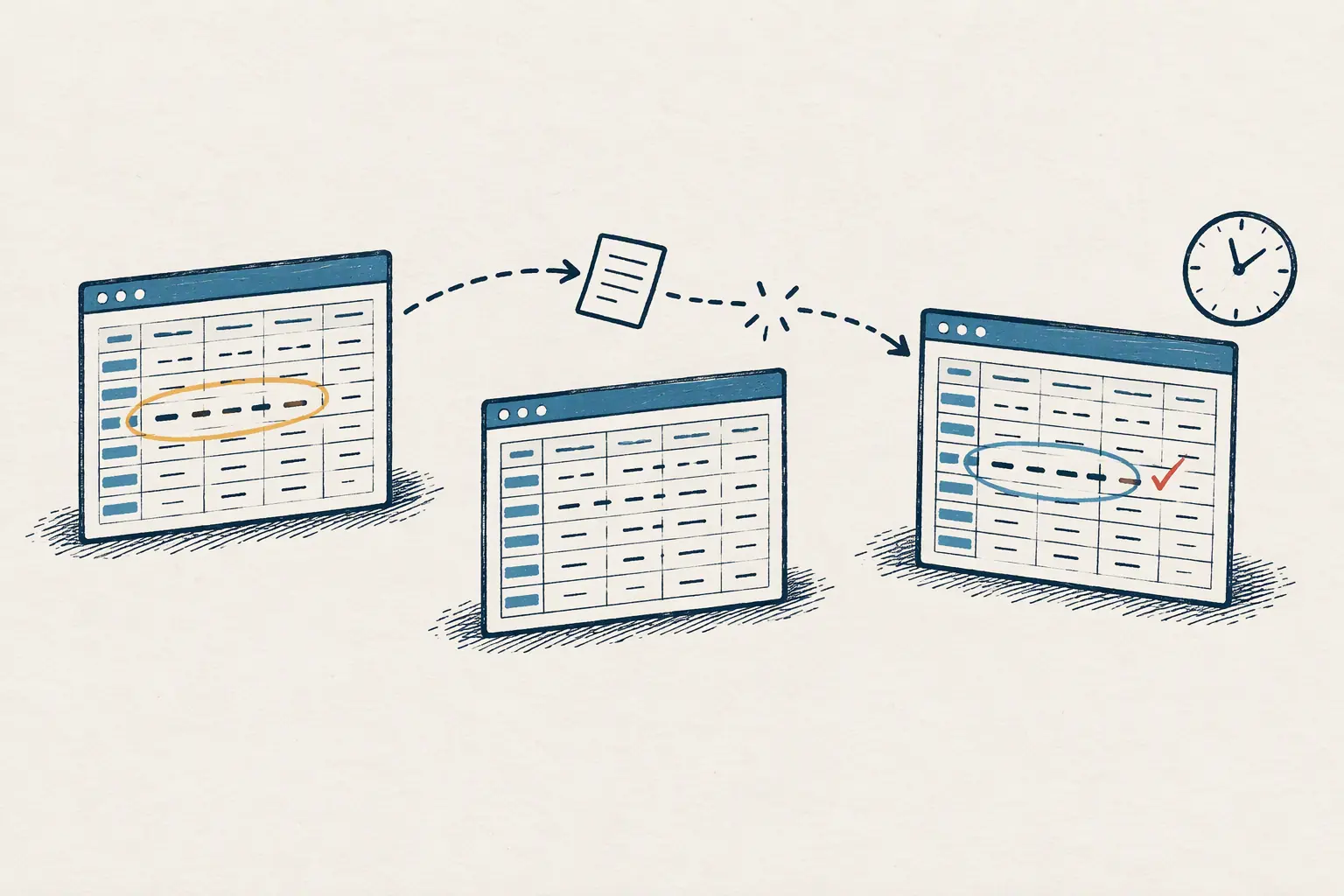
Nearly every business we meet starts the same way: one person builds a spreadsheet for their own needs, a teammate starts using it, another team makes their own version. Nothing is wrong at first. The cost only shows up years later, when those files have become the backbone of daily work.
By then sales data sits in one file, stock in another, finance in a third. Every month-end someone copies numbers from one screen to the next. The work is quiet and rarely complained about, which is exactly why it is rarely examined: small differences slip through, file versions branch, and a report that should be finished early in the month runs late without anyone able to point at the cause.
The pattern survives because it feels normal. Everyone is busy, and everyone’s way feels the most practical. Yet every manual handoff is a small place where errors enter without leaving a trace.
Integration starts with a map of the data flow
The first step we take in a situation like this usually happens far from any software: we map where data actually flows, who produces it, who consumes it, and where it gets retyped. The map is almost always simpler than expected, and that is where the first worthwhile connections become visible.
Signs the pattern has started to cost you:
- The same number appears differently in two reports.
- There is routine work whose content is copying data from one system to another.
- One person becomes the reference because only they understand the file structure.
- File versions are distinguished by name, date, or the word “final”.
Connecting systems rarely means throwing away what already works. Often it is enough to designate one authoritative data source and have the other applications read from it, so the same number no longer lives in several places at once.
If the picture above feels familiar, a short conversation is usually enough to see whether the same pattern is running at your company. From there we can discuss which links deserve to be connected first. That is the work we do as part of our system integration service.
Related Articles
Cloud & DevOps 3 min read
Releases That Only Happen After Office Hours
As long as going back to the previous version means hunting for a backup folder, every release becomes an event people dread.
Custom Software Development 3 min read
The System Only One Person Can Touch
When one person is the only one who understands it, every change ends up waiting for them to be available.
IT Consulting 3 min read
A Design That Still Holds When the Business Doubles
The first load always feels light. What tests a design is the year the volume has multiplied several times over.
Want to Apply These Ideas to Your Business?
Let’s discuss how this approach can be adapted to your organization’s context.
Start a Conversation